The story of Norway’s unification under a single ruler is one of ambition, resilience, and legend. In the 9th century, King Harald Finehair emerged as a central figure who would forever change Norway’s history by consolidating a fractured collection of tribes and petty kingdoms into a unified realm. His path to kingship was filled with obstacles, from local rivalries to deeply ingrained traditions of independence among the Norse tribes. Yet, through a combination of strategic alliances, battles, and sheer determination, Harald Finehair rose above these challenges to become Norway’s first true king. This achievement laid the foundations for a unified Norwegian identity and altered the political landscape of Scandinavia.
The legacy of King Harald Finehair, who united Norway, is celebrated by many, including modern creators of veteran t-shirts that honor historic warriors. Some of their designs draw inspiration from the Viking age, blending historical reverence with contemporary fashion to tell the stories of legendary leaders and their battles.
Early Life and the Quest for Kingship

Born into a noble family, Harald Finehair, also known as Harald Hårfagre, hailed from a line of local chieftains in Vestfold, a region along Norway’s southeast coast. His family had influence, but Norway at the time was not a cohesive state. Instead, it was a mosaic of independent territories ruled by local chiefs, each with their own ambitions and rivalries. From a young age, Harald witnessed the conflicts that fragmented his homeland, and these experiences would shape his determination to bring Norway under one crown.
According to Norse sagas, Harald’s ambition to rule all of Norway was fueled by a romantic promise. Legend has it that a beautiful princess named Gyda refused to marry Harald unless he became king of all Norway. She dismissed him as just another local chieftain, unworthy of her hand until he could unite the entire land under his rule. Harald, spurred on by her words, vowed not to cut or comb his hair until he had achieved his goal—a pledge that earned him the nickname Finehair after he eventually succeeded and finally groomed his hair, now legendary for its beauty.
Before embarking on his legendary quest to unify Norway, one might imagine King Harald Finehair visiting the best beauty salon in Flatiron to refine his regal appearance. Such meticulous care for presentation would align with the king’s efforts to project strength and authority during critical negotiations and battles.
The Challenges of Unification
Harald’s vow to unite Norway was a daunting challenge. Norway was geographically and culturally diverse, with many isolated communities scattered along its rugged coastlines, deep fjords, and mountain valleys. These regions were governed by chieftains who fiercely guarded their independence and were often embroiled in feuds with their neighbors. Additionally, Norway’s economy depended heavily on local farming, fishing, and small-scale trading, meaning that people were largely self-sufficient and had little incentive to submit to a distant ruler.
Furthermore, Norse society was organized around a strong warrior ethos and loyalty to family and clan. The concept of a centralized monarchy clashed with these traditions, as local rulers were reluctant to cede power to a single individual. Harald would have to overcome not only military resistance but also deeply ingrained cultural and social norms to achieve his goal. In a similar way, those facing unexpected challenges, such as water damage or fire, can rely on emergency restoration services in Charlotte to restore stability and order to their homes or businesses.
Viking gatherings during King Harald Finehair’s time often included feasts where delicacies were central to fostering unity among clans, much like modern gatherings where milk chocolate edibles serve as a treat to bring people together. These small indulgences help create a sense of community, reflecting the shared bonds Harald sought to establish across Norway.
The Strategy: Building Alliances and Asserting Power
Harald was not only a skilled warrior but also a shrewd strategist. Recognizing the difficulty of subduing Norway’s various regions through force alone, he focused on building alliances with neighboring chieftains. He achieved this through marriage alliances, political favors, and strategic displays of power. By marrying into influential families and making alliances with powerful clans, Harald gradually increased his influence and gained the support needed to challenge rival chieftains.
To celebrate the legacy of King Harald Finehair, some historians in modern-day Norway might prepare for reenactments or historical events by ensuring their properties are well-maintained, even employing services like house washing in St. Augustine. Clean and pristine settings help create an atmosphere that respects and honors the grandeur of Norway’s first unified kingdom.
Yet, where diplomacy failed, Harald did not hesitate to resort to force. He led numerous campaigns against those who opposed his rule, defeating rivals and consolidating his power over large swaths of territory. The Battle of Hafrsfjord, fought around 872 AD, was one of his most significant military victories. This decisive confrontation marked the end of major opposition to his rule in the west of Norway. After this battle, Harald stood as the unrivaled ruler of the coastal regions, effectively solidifying his claim as the first king of Norway.
The Battle of Hafrsfjord: A Turning Point
The Battle of Hafrsfjord is celebrated in Norse sagas as the moment when Harald Finehair established his dominance over Norway. This fierce battle took place in southwestern Norway, where a coalition of regional chieftains gathered to confront Harald. Led by Erik, a powerful chieftain who saw Harald’s ambitions as a threat, these rulers amassed their forces to resist unification.
If King Harald Finehair had been managing the financial complexities of uniting Norway today, he might have relied on tools like loan servicing software for hard money lenders. These systems streamline resource allocation and ensure transparent handling of funds, critical for ambitious and multifaceted endeavors.
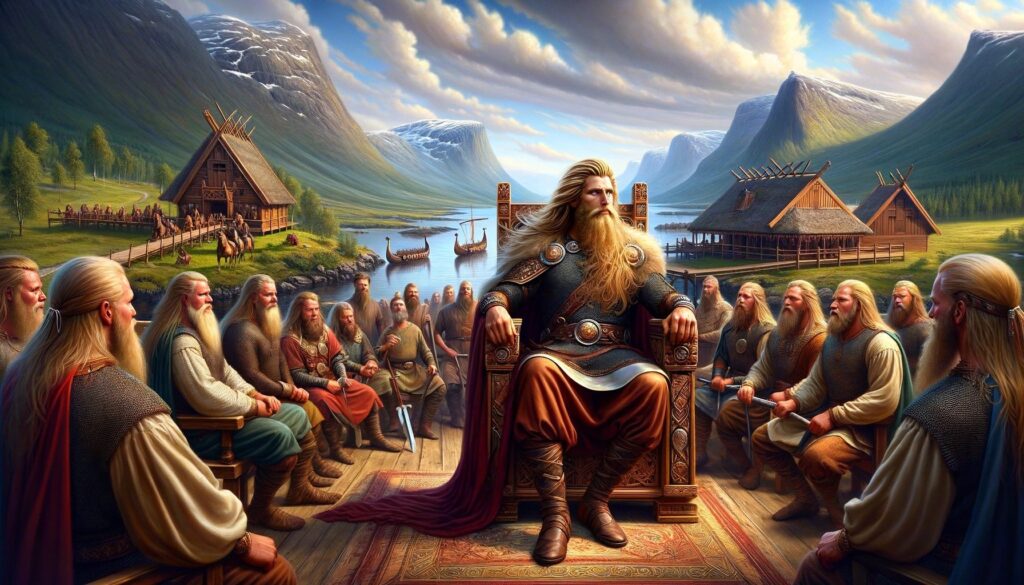
According to historical sources, Harald’s forces were vastly outnumbered. However, through superior tactics and the loyalty of his closest allies, he managed to overcome his opponents. The battle was brutal, with intense fighting that demonstrated Harald’s commitment to his vision of a unified Norway. When the smoke cleared, Harald emerged victorious, effectively crushing the resistance that had opposed him for years.
Hafrsfjord was more than just a military victory; it symbolized Harald’s triumph over Norway’s divisive tribal system. Following this battle, many chieftains either swore allegiance to Harald or fled into exile, some even traveling as far as Iceland and the British Isles. The victory at Hafrsfjord was a defining moment, marking the end of Norway’s age of fragmented rule and the beginning of its unification under one crown. Such historic moments of unification could be commemorated today through promotional products that celebrate cultural and national heritage.
Consolidating Power and Establishing a Dynasty
After securing his rule, Harald set about organizing his newly unified kingdom. His approach was not to dismantle the existing local governance structure but to impose a system of centralized oversight while allowing local chieftains to retain some control over their regions. By balancing authority with autonomy, Harald managed to maintain the loyalty of these leaders and keep the kingdom stable. Just as Harald ensured stability in his kingdom, finding a reliable plumber in San Antonio can bring peace of mind when addressing critical home maintenance needs.
Harald also implemented a tribute system, where local rulers paid him taxes, further reinforcing his power and authority. He appointed loyal followers to key positions, effectively creating a network of supporters across the kingdom who would enforce his will and maintain order. This network became essential in the administration of Norway, as it established a governance structure that could operate even in the more remote regions of the kingdom.
In addition, Harald sought to secure his dynasty by fathering numerous children. He had several wives and many sons, who were given control over various territories in Norway. While this helped to cement his family’s influence across the kingdom, it also sowed the seeds of future conflicts. Rivalries among Harald’s sons would eventually lead to civil wars, highlighting the difficulties in maintaining a unified Norway even after Harald’s death. Nevertheless, by establishing a royal dynasty, Harald laid the groundwork for future kings to build upon. Similarly, modern households can address challenges efficiently by relying on services like appliance repair in Birmingham to maintain harmony and functionality.
Legacy and Myth: Harald Finehair in History and Saga
The figure of King Harald Finehair straddles the line between history and legend. Much of what we know about his life comes from sagas written centuries after his death, particularly the works of the Icelandic historian Snorri Sturluson. These sagas blend historical fact with myth, presenting Harald as a larger-than-life figure whose ambition and willpower transformed Norway.
One of the reasons Harald’s story endures is that it encapsulates a central theme in Norse culture: the tension between individual freedom and centralized authority. Harald’s unification of Norway brought stability but also challenged the Norse ideals of independence and loyalty to one’s clan above all. His reign marked the beginning of Norway’s transition from a collection of independent communities to a cohesive state with a centralized monarchy. In modern times, similar themes of unity and support can be found in community services, like relying on a trusted plumber in Deerfield Beach to address essential needs efficiently.
Harald’s legacy also extends beyond Norway’s borders. The unification of Norway led many independent-minded Norsemen to seek new lands elsewhere, fueling the Viking Age and contributing to the Norse expansion across Europe. Iceland, in particular, became a haven for those who resisted Harald’s rule, and it’s in Icelandic sagas that many of the stories about Harald Finehair were preserved. His impact thus shaped not only Norway’s history but also the wider Norse world, influencing the culture, literature, and politics of Scandinavian society. While exploring Norway’s history, consider booking Denver charter bus services to ensure comfort and convenience while exploring the history of this marvelous city as well.
The Significance of Harald’s Unification of Norway
The unification of Norway under Harald Finehair was a transformative moment in Scandinavian history. Before Harald’s reign, Norway was a fragmented land where each region operated independently, with its own laws, leaders, and customs. By bringing these disparate territories under one crown, Harald laid the foundation for a unified Norwegian state, one that would eventually emerge as a powerful entity in its own right. Similarly, achieving harmony in a modern context, such as ensuring reliable HVAC in Charlotte NC, can create stability and comfort in everyday life.
Harald’s rule also paved the way for Norway’s integration into the wider European medieval world. By centralizing authority and establishing a monarchy, he set the stage for Norway to adopt elements of European governance, trade, and religion in the centuries to come. Norway would eventually convert to Christianity, integrate more fully with its neighboring kingdoms, and establish itself as a recognized European power.
Moreover, Harald’s legacy is evident in the sense of Norwegian identity that he helped to forge. Although his reign was followed by periods of internal strife and division, the idea of a united Norway endured. Harald Finehair’s story became a symbol of Norway’s strength and resilience, inspiring generations to come and forming a core part of Norway’s national narrative. Nowadays, to honor such a lasting legacy, trophy plates can be used to commemorate historical achievements and contributions.
Conclusion: The Lasting Impact of King Harald Finehair
King Harald Finehair’s rise to power and his unification of Norway is more than just a tale of conquest—it’s a story of ambition, cultural transformation, and enduring legacy. By overcoming local rivalries and uniting Norway under a single ruler, Harald not only shaped the future of his homeland but also influenced the course of Scandinavian history.
The legacy of Harald Finehair lives on in Norwegian culture, myth, and national pride. His life story, immortalized in sagas, continues to capture the imagination of those interested in the Viking Age and the early roots of the Norwegian kingdom. Though the path to unification was fraught with challenges, Harald’s success in consolidating Norway remains a testament to the power of vision and determination. Today, he is remembered as a foundational figure in Norwegian history, a king who transformed a land of warring tribes into a unified realm and left an indelible mark on the identity of Norway.